หน้าแรก
» Share
»
Habit Stacking: A Practical System for Making Routines Stick
Habit Stacking: A Practical System for Making Routines Stick
You decide to stretch every morning, read every night, drink more water, or plan your day before opening email. The intention is clear. The problem is remembering to act at the right moment, especially once the novelty wears off.
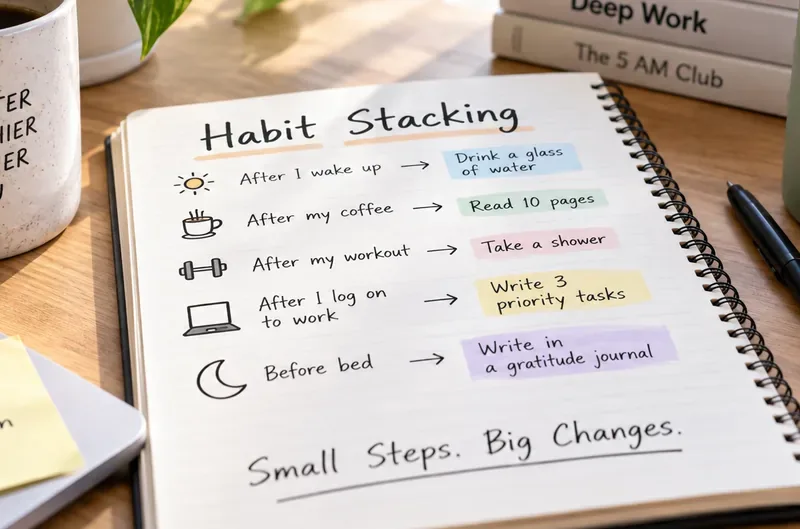
Habit stacking is a practical way to reduce that problem. You attach a small new behavior to something that already happens reliably: after I do X, I will do Y. In behavioral-science terms, this resembles an implementation intention combined with repeated behavior in a stable context. The phrase “habit stacking” is a popular label, not a single standardized scientific protocol, so the useful question is not whether the label itself has been clinically validated. It is whether its underlying ingredients—clear cues, specific plans, repetition, and context stability—are supported by evidence.
A practical habit stack pairs a reliable existing cue with one small, clearly defined action that can be repeated in the same context.
Habit stacking in one sentence
Use an action you already perform consistently as the cue for a small behavior you want to repeat. A simple template is: “After I [existing routine], I will [new behavior].”
That structure matters because habits are strongly tied to context. A major review of habit mechanisms describes habits as learned links between recurring context cues and responses. Once those links become strong, the context itself can help activate the response. See the original Psychological Review paper on habits and context-response associations.
What the research actually supports
Practical idea
Evidence behind it
What not to assume
Specify the cue and action in advance
Implementation-intention research uses an “if situation Y, then behavior X” structure. A 2006 meta-analysis of 94 independent tests found a positive effect on goal attainment.
A plan does not guarantee the behavior will become automatic.
Repeat the behavior in a stable context
Habit research links repetition in recurring contexts with stronger cue-response associations and increasing automaticity.
There is no universal number of repetitions that works for everyone.
Keep the action feasible enough to repeat
Real-world habit-formation studies show automaticity develops gradually and varies greatly by behavior and person.
Missing one opportunity does not mean the habit is “reset.”
The implementation-intention evidence comes from Gollwitzer and Sheeran’s original meta-analysis in Advances in Experimental Social Psychology. It found that plans specifying when, where, and how to act helped people translate intentions into action across many settings. Habit stacking borrows a similar logic by making the cue explicit.
สำหรับการสร้างนิสัยนั้น ลัลลีและเพื่อนร่วมงานได้ติดตามผู้คนในการเลือกพฤติกรรมการกิน ดื่ม หรือทำกิจกรรมประจำวันในบริบทเดียวกันเป็นเวลา 12 สัปดาห์ โดยทั่วไปแล้ว ความสามารถในการทำโดยอัตโนมัติจะเพิ่มขึ้นเมื่อมีการทำซ้ำ แต่ระยะเวลาที่ใช้มีความแตกต่างกันอย่างมาก งานวิจัยต้นฉบับมีอยู่ในวารสาร European Journal of Social Psychology