หน้าแรก
» เทคโนโลยี
»
IoT and AI in Action: How Smart Cities Are Cutting Urban Carbon Footprints
IoT and AI in Action: How Smart Cities Are Cutting Urban Carbon Footprints
The most important point is simple: smart cities reduce carbon when connected sensors do more than collect data. The useful pattern is a closed loop: Internet of Things (IoT) devices measure what is happening, software analyzes the data, and automated controls or city operators change a physical system that uses energy or fuel. That can mean reducing unnecessary cooling, retiming traffic signals, dimming streetlights when streets are empty, shifting electricity demand, or routing service vehicles more efficiently.
That distinction matters because a city can install thousands of sensors and still achieve little climate benefit if the data never changes how infrastructure operates. The strongest projects start with a measurable emissions problem, connect the data to an operational decision, and then verify the result against a baseline.
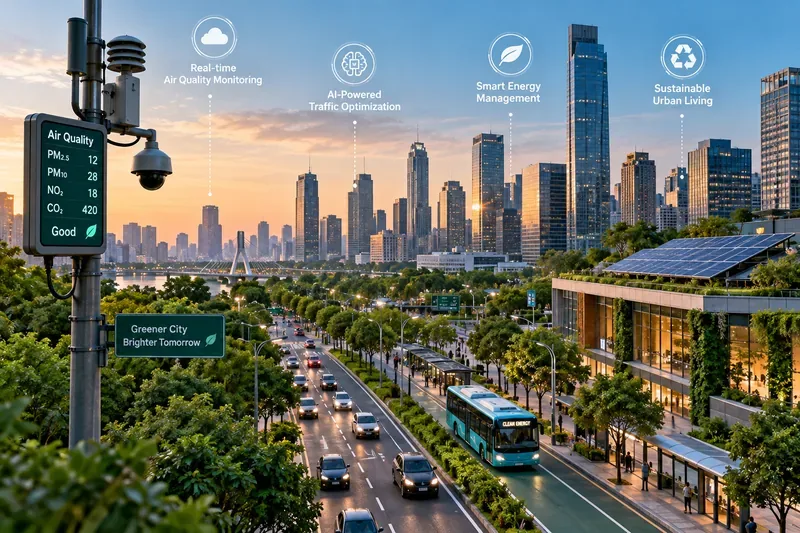
A connected urban district can combine environmental sensing, traffic optimization, public transit, rooftop solar, and smart building controls. The carbon benefit comes from how those systems change energy and fuel use, not from connectivity alone.
Why IoT and AI can matter so much in cities
Cities concentrate buildings, transport, public lighting, utilities, and other energy-intensive services in a relatively small area. The International Energy Agency (IEA) has estimated that cities generate around 70% of global carbon dioxide emissions, which is why better urban energy management can have outsized impact. The IEA's Empowering Cities for a Net Zero Future report explains that digital systems can help cities manage energy in real time and coordinate infrastructure more efficiently.
IoT and AI play different roles. IoT provides the observations: occupancy, temperature, electricity use, traffic speed, parking availability, equipment condition, light levels, or air quality. AI and advanced analytics can then detect patterns, forecast demand, flag anomalies, or recommend a better control setting. The final step is operational: a thermostat changes, a pump slows down, a traffic signal changes timing, a battery charges at a different hour, or a maintenance crew is dispatched before equipment wastes more energy.
1. Smart buildings and district energy are among the clearest carbon opportunities
Heating, cooling, ventilation, and lighting are good targets because they consume large amounts of energy and are often operated using fixed schedules. Occupancy sensors, smart meters, equipment telemetry, and weather data can show what a building actually needs instead of assuming every space needs the same service all day.
The IEA's 2025 Energy and AI analysis gives a useful scale for the opportunity: optimized heating, ventilation, and air-conditioning control can save around 10% of energy consumption in buildings equipped with management systems. That is an example of technical potential, not a guarantee for every building. Savings depend on the baseline, climate, equipment condition, occupancy patterns, and how aggressively the control system is allowed to operate.
Singapore's Punggol Digital District provides a concrete current example. JTC's page, last updated July 10, 2026, says the district has more than 20,000 sensors collecting real-time information on building performance, occupancy, environmental conditions, and energy use. According to JTC, AI and machine-learning algorithms can use those streams to achieve up to 20% energy savings. The same district combines a smart grid, rooftop solar, district cooling, and a digital twin; JTC reports a 35% reduction in annual carbon emissions for the integrated district design. The details are available in JTC's Punggol Digital District sustainability overview.
For a city or property owner considering this approach, the best fit is a portfolio with central building management, significant HVAC loads, predictable occupancy patterns, and enough submetering to establish a trustworthy baseline. A small building with already-efficient controls may have much less headroom.
2. AI-assisted traffic management can reduce wasted fuel—but only under the right conditions
Traffic is a natural use case because road conditions change minute by minute. Cameras, connected signals, road sensors, tolling systems, and vehicle-location data can provide the inputs for adaptive traffic control. AI can then predict congestion, improve route choice, identify incidents, or change signal timing.
The IEA's 2025 analysis says improved route choice and driving characteristics can produce efficiency gains of roughly 5% to 10% in transport applications. Again, that figure is a modeled or application-level estimate, not a universal city result.
Singapore offers a useful example of how this is being implemented rather than merely discussed. In an August 4, 2026 parliamentary reply, the Ministry of Transport said the Land Transport Authority is experimenting with ERP 2 data to dynamically optimize traffic signals through the Cooperative and Unified Smart Traffic System, or CRUISE. It is also expanding AI-powered video analytics for earlier incident detection. The official description is in the Ministry's traffic-management update.