หน้าแรก
» เทคโนโลยี
»
Where Should You Study Embodied AI in 2026? Top Universities and Programs by Career Goal
Where Should You Study Embodied AI in 2026? Top Universities and Programs by Career Goal
As of September 2026, the clearest sign that embodied AI is becoming a real academic pathway is not a wave of degrees carrying the exact phrase “Embodied AI.” It is the way leading robotics programs are making embodiment, robot learning, and multimodal foundation models more explicit in their curricula and research. Carnegie Mellon University’s current Master of Science in Robotics curriculum names Robot Embodiment as one of four core areas, while ETH Zurich’s Spring 2026 Robot Learning course progressed from imitation and reinforcement learning to Vision-Language-Action (VLA) models and foundation models for robotics.
That distinction matters if you are choosing where to study. The best program is rarely the one with the trendiest label. It is the one that gives you the right combination of perception, control, planning, machine learning, hardware, simulation, real-robot experimentation, and research or product-development experience for the work you want to do.
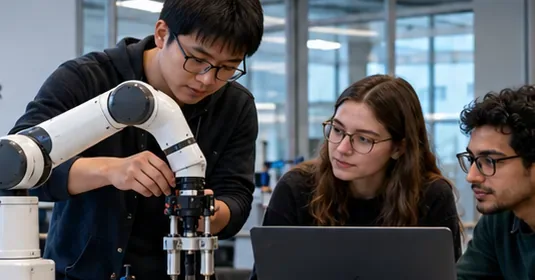
Graduate students work with a robotic arm and laptop in a university robotics lab, illustrating the hands-on mix of perception, control, hardware, and machine learning central to embodied AI.
Do You Need a Degree Called “Embodied AI”?
No. In 2026, many of the strongest routes into embodied AI still sit inside robotics, computer science, electrical engineering, or mechanical engineering programs rather than degrees with “Embodied AI” in the title.
Embodied AI generally refers to intelligent systems that must perceive a physical environment, reason about it, and take actions through a body such as a robot. A serious program should therefore go beyond large language models or computer vision in isolation. Look for a curriculum that connects several of these areas:
Perception: computer vision, 3D sensing, tactile sensing, state estimation, and multimodal perception.
Action: robot control, manipulation, locomotion, task and motion planning, and autonomy.
Foundation models: vision-language models, VLA models, multimodal reasoning, and scalable robot data pipelines.
Embodiment: kinematics, dynamics, mechatronics, sensors, actuators, contact, and the constraints imposed by a physical robot.
Systems: software integration, real-time computing, safety, evaluation, human-robot interaction, and deployment on real hardware.
For a useful benchmark, review the Carnegie Mellon MS in Robotics curriculum, which currently organizes core study around sensing and perception, thinking about actions, robot embodiment, and environment interaction.
Which Universities Offer the Strongest Fit for Embodied AI?
The following programs are strong choices for different reasons. This is a fit-based comparison, not a prestige ranking, and it is not exhaustive. Course offerings, lab capacity, advisers, and admissions policies can change, so verify the current official program pages before applying.
University and route
Best fit
What makes it relevant to embodied AI
Main trade-off
Carnegie Mellon — MS in Robotics (MSR)
Research-intensive master’s
Explicit Robot Embodiment core area, perception, action, environment interaction, and substantial supervised research
Two-year research commitment; funding is not guaranteed
Carnegie Mellon — MS in Robotic Systems Development (MRSD)
Industry and robotics product development
Robot autonomy, manipulation, control, systems projects, technical electives, internship, and business training
Less thesis-oriented than MSR
Stanford — MS CS AI specialization or CS PhD + robotics labs
Robot learning, manipulation, multimodal AI, research breadth
AI specialization includes robotics; REAL focuses directly on learning from interaction with the physical world
The MS is a broad terminal CS degree, not a dedicated robotics master’s
MIT — EECS PhD + CSAIL Embodied Intelligence
Doctoral research in embodied intelligence
CSAIL integrates perception, sensing, language, learning, planning, and intelligent robotics
MIT EECS does not offer a terminal master’s for external applicants
ETH Zurich — MSc Robotics, Systems and Control
Structured technical master’s in Europe
Robotics, perception, modeling, control, planning, and current robot-learning work including VLA models
Advanced electives can vary by semester; a notable 2026 VLA course is listed as non-recurring
University of Pennsylvania — Robotics MSE
Balanced robotics master’s with GRASP access
AI, robot design, control, perception, learning, and active work on physical reasoning and robot manipulation
Embodied AI is a research direction within a broader robotics degree
Georgia Tech — MS in Robotics
Professional, industry-oriented robotics training
AI plus mechanics, industrial internship, capstone, physical testbeds, multimodal perception, sim-to-real, planning, and safety
Designed more for professional practice than a thesis-first research trajectory
Which Program Is Best If You Want to Become an Embodied AI Researcher?
Carnegie Mellon’s MS in Robotics is one of the clearest master’s-level choices. The current MSR program is research-driven, normally takes 24 months, and requires at least 84 Carnegie Mellon credits of supervised research in addition to coursework. Students finish with a thesis document and public thesis talk. Most importantly for this topic, the curriculum explicitly places Robot Embodiment alongside Sensing and Perception, Thinking about Actions, and Environment Interaction as a foundational area.
That structure is unusually aligned with embodied AI because it prevents the degree from becoming “machine learning with a robot demo.” You are expected to understand how sensing, physical design, action, and interaction constrain intelligence. Read the official CMU MS in Robotics overview and current MSR curriculum.
For applicants working on a 2027 start, there is also a time-sensitive point: CMU states that the MSR application portal is open from September 9 through December 9, 2026 at 3 p.m. EST, with successful applicants beginning in Fall 2027. The program says GRE scores are optional. Verify details on the CMU MSR application page.
What if you want to build complete robot products instead of writing a thesis?
At the same university, CMU’s Master of Science in Robotic Systems Development is a different proposition. Its 21-month curriculum combines robot autonomy, manipulation, estimation and control, team projects, business courses, and a summer internship. That makes MRSD a better fit for students who want to become robotics engineers, systems leads, or technical product builders rather than focus primarily on academic research. See the CMU MRSD curriculum.
Should You Choose Stanford for Embodied AI?
Choose Stanford if you want broad AI training plus access to a particularly active robot-learning ecosystem. Stanford’s Robotics and Embodied Artificial Intelligence Lab, or REAL, states its goal directly: developing algorithms that let intelligent systems learn from interactions with the physical world to execute complex tasks and assist people. Its 2026 research includes bimanual mobile manipulation, continual robot learning, whole-body visuomotor control, and embodiment-aware policy work. See the Stanford REAL lab.
The academic route requires more care than the lab name suggests. Stanford’s MS in Computer Science is a 45-unit terminal professional degree that takes about 1.5 years on average for full-time students. Its Artificial Intelligence specialization includes robotics along with machine learning, probabilistic modeling, reasoning, and related AI topics. Review the Stanford CS master’s overview and AI specialization description.
หากคุณต้องการเรียนต่อปริญญาโทด้านปัญญาประดิษฐ์เชิงกายภาพ (Embodied AI) MIT เป็นตัวเลือกที่ดีหรือไม่?
MIT เป็นสถาบันวิจัยด้านปัญญาประดิษฐ์เชิงกายภาพที่แข็งแกร่ง แต่ไม่ใช่ทางเลือกที่เรียนจบปริญญาโทโดยตรงในสาขาวิศวกรรมไฟฟ้าและวิทยาการคอมพิวเตอร์ ชุมชนวิจัยปัญญาประดิษฐ์เชิงกายภาพของ MIT CSAIL รวบรวมการรับรู้ การสัมผัส ภาษา การเรียนรู้ และการวางแผนเข้าด้วยกันอย่างชัดเจน เพื่อศึกษาพฤติกรรมอัจฉริยะในโลกทางกายภาพและสร้างหุ่นยนต์อัจฉริยะ สมาชิกในชุมชนครอบคลุมด้านการเรียนรู้ของหุ่นยนต์ การจัดการ การวางแผน การรับรู้ ความเป็นอิสระ และปฏิสัมพันธ์ระหว่างมนุษย์กับหุ่นยนต์ ดูรายละเอียดเพิ่มเติมได้ที่MIT CSAIL Embodied Intelligence Community of Research
โครงสร้างการรับสมัครเป็นรายละเอียดที่สำคัญที่สุด MIT EECS ระบุว่าการสมัครเข้าศึกษาต่อระดับบัณฑิตศึกษาของที่นี่มีไว้สำหรับหลักสูตรปริญญาเอกเท่านั้น ไม่มีปริญญาโทขั้นสุดท้ายสำหรับผู้สมัครจากภายนอก EECS แม้ว่านักศึกษาปริญญาเอกจะได้รับปริญญาโทในระหว่างทางไปสู่ปริญญาเอกก็ตาม หลักสูตร MEng จำกัดเฉพาะนักศึกษาปริญญาตรีของ MIT EECS ที่มีคุณสมบัติเหมาะสม ตรวจสอบกระบวนการรับสมัครเข้าศึกษาต่อระดับบัณฑิตศึกษาของ MIT EECSได้ที่นี่
นั่นหมายความว่า MIT เหมาะที่สุด สำหรับผู้สมัครที่ต้องการเจาะลึกงานวิจัยโดยเริ่ม จากปริญญาเอกก่อน แต่หากคุณต้องการเรียนปริญญาโทด้านหุ่นยนต์แบบเดี่ยวๆ สักหนึ่งหรือสองปีก่อนเข้าทำงานในอุตสาหกรรม CMU, ETH Zurich, Penn หรือ Georgia Tech จะมีโครงสร้างหลักสูตรที่ตรงกว่า
โปรแกรมใดเหมาะสมที่สุดสำหรับโมเดลการมองเห็น-ภาษา-การกระทำ (Vision-Language-Action Models) และโมเดลพื้นฐานของหุ่นยนต์ (Robot Foundation Models)?
หากคุณต้องการเรียนปริญญาโทด้านหุ่นยนต์ที่มีโครงสร้างชัดเจนและทันสมัย พร้อมทั้งติดตามวิธีการเรียนรู้ของหุ่นยนต์ล่าสุด ETH Zurich สมควรได้รับความสนใจเป็นพิเศษหลักสูตร MSc ในสาขาหุ่นยนต์ ระบบ และการควบคุมของที่นี่มีหน่วยกิต 90 ECTS ใช้เวลาเรียน 1.5 ปี สอนเป็นภาษาอังกฤษ ครอบคลุมด้านหุ่นยนต์ การสร้างแบบจำลองทางกายภาพ การควบคุม การรับรู้ การวางแผน และระบบอัจฉริยะ คำอธิบายหลักสูตรอย่างเป็นทางการเน้นย้ำว่าระบบอัจฉริยะต้องรับรู้และตีความสภาพแวดล้อม และตัดสินใจกระทำการใดๆ จากข้อมูลเหล่านั้น ดูรายละเอียดเพิ่มเติมได้ที่ETH Zurich MSc Robotics, Systems and Control
สัญญาณที่เกี่ยวข้องอย่างยิ่งในปี 2026 คือหลักสูตรRobot Learning: From Fundamentals to Foundation Models ของ ETH แคตตาล็อกภาคเรียนฤดูใบไม้ผลิปี 2026 ระบุว่านักศึกษาจะก้าวหน้าจากการเรียนรู้แบบเลียนแบบ การเรียนรู้แบบเสริมแรง และการเพิ่มประสิทธิภาพนโยบาย ไปสู่แบบจำลอง VLA และแบบจำลองพื้นฐานสำหรับหุ่นยนต์ โดยมีการนำไปใช้ในการจำลองและบนหุ่นยนต์จริง นอกจากนี้ยังครอบคลุมถึงไปป์ไลน์ที่ปรับขนาดได้ซึ่งบูรณาการการรับรู้ การควบคุม และการให้เหตุผลแบบหลายรูปแบบ โปรดตรวจสอบหลักสูตรRobot Learning ของ ETH ภาคเรียนฤดูใบไม้ผลิปี 2026