หน้าแรก
» เทคโนโลยี
»
Where to Study Carbon Capture Engineering in 2026: Strong Environmental and CCUS Programs
Where to Study Carbon Capture Engineering in 2026: Strong Environmental and CCUS Programs
Carbon capture engineering is becoming a more defined field of study, and 2026 has brought a useful change for prospective students: universities are moving beyond one-off electives and research groups toward dedicated CCUS credentials. The University of Calgary, for example, now lists a new Carbon Capture, Utilization and Storage specialization in its Advanced Engineering Practice graduate certificate, while Colorado School of Mines offers both a dedicated online master’s degree and a graduate certificate in CCUS.
That shift reflects what is happening in the industry. In its March 2026 update, the International Energy Agency reported that carbon-capture capacity that was operational or under construction was more than 10% higher than in the previous edition of its CCUS Projects Database. The IEA also reported more than 30 final investment decisions for CCUS projects over the prior two years and more than $5 billion of investment in 2025. See the IEA’s March 2026 CCUS update and its Financing CCUS at Scale report.
For students, the practical consequence is important: there is no single “best” carbon capture engineering degree for everyone. Capture chemistry, process design, CO₂ transport, geological storage, monitoring, permitting, life-cycle assessment, and project economics require different technical backgrounds. The programs below are therefore compared by fit, not placed in a simple prestige ranking.
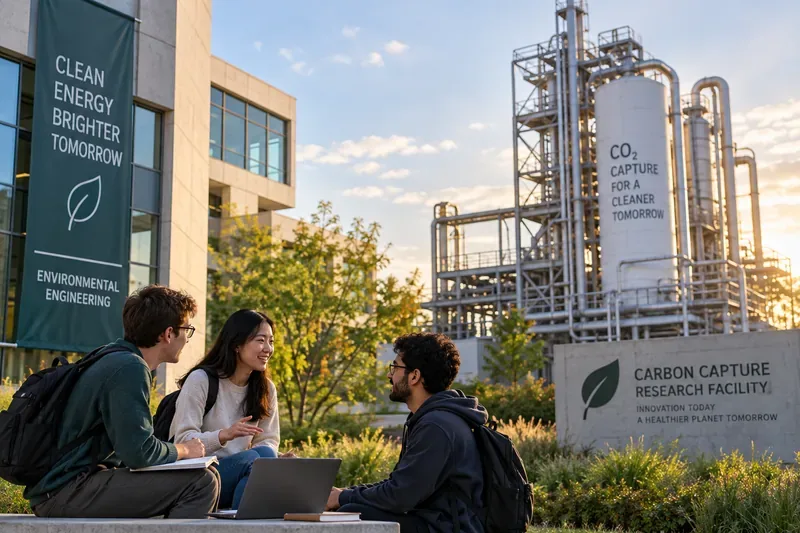
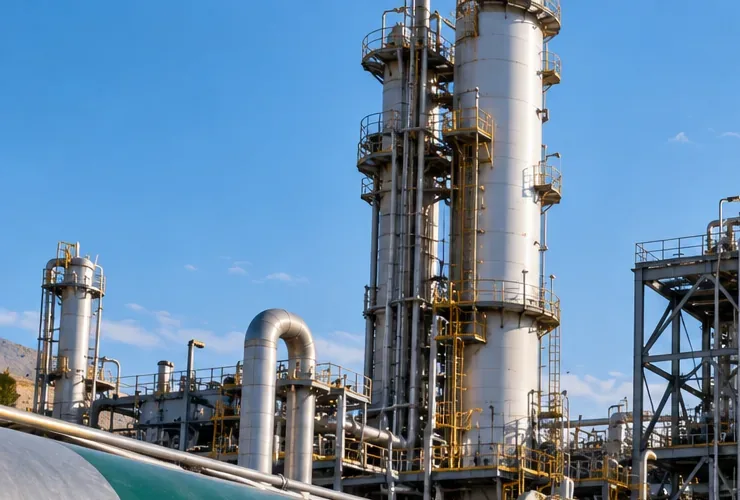
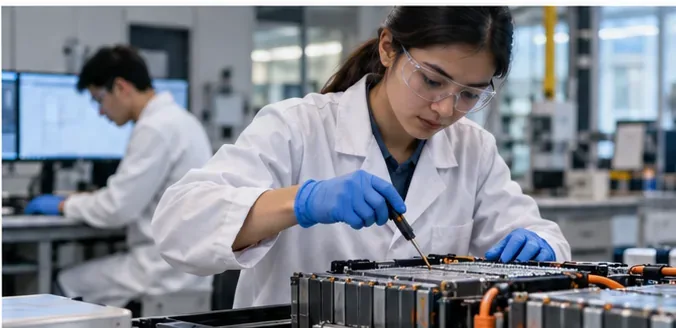
Graduate students discuss engineering work beside a modern carbon-capture research setting, reflecting the field’s mix of process engineering, environmental systems, and subsurface science.
What Does “Carbon Capture Engineering” Actually Cover?
Most jobs described as carbon capture, CCS, or CCUS engineering sit somewhere along a chain. At the front end, chemical and process engineers work on separating CO₂ from flue gas or process streams using solvents, sorbents, membranes, cryogenic methods, or other separation systems. They need thermodynamics, heat and mass transfer, process control, and process simulation.
Storage-focused engineers work farther downstream. They evaluate reservoirs, model multiphase flow, study geochemistry and geomechanics, design injection wells, and plan monitoring. In the United States, long-term geologic sequestration can also involve Class VI well requirements under the Underground Injection Control program. The U.S. Environmental Protection Agency’s Class VI overview is a useful example of why regulatory and environmental-risk knowledge matters alongside technical design.
A third path focuses on carbon management as a system: life-cycle assessment, techno-economic analysis, policy, community engagement, infrastructure planning, and measurement, reporting, and verification. Strong programs increasingly connect these areas rather than treating carbon capture as an isolated unit operation.
Best-Fit Programs for Carbon Capture, Storage, and Environmental Engineering
The following options were selected because their official 2026 or 2027 program pages explicitly identify carbon capture, CCUS, geological CO₂ storage, or closely related research as part of the curriculum. Program names and availability can change, so always recheck the official page before applying.
Program
Format
Strongest fit
What stands out
Colorado School of Mines — MS in Carbon Capture, Utilization and Storage
Fully online
End-to-end CCUS systems
Dedicated 30-credit non-thesis degree with capture, subsurface, policy, and economics options
University of Calgary — CCUS Graduate Certificate specialization
In-person evening classes; four courses over 16 months
Working engineers and applied field training
CCUS, subsurface energy, data science, life-cycle assessment, and access to a field research station
University of Manchester — MSc Subsurface Energy Engineering
Carbon dioxide capture and utilization taught within a materials-chemistry program with a substantial research project
Imperial College London — MSc Advanced Chemical Engineering
1 year, full-time
Process engineering and capture systems
Advanced chemical engineering with an optional Carbon Capture and Clean Fossil Fuels module
University of Cambridge — MPhil in Energy Technologies
11 months, full-time
Broad energy engineering with research specialization
Strong fundamentals plus a research project; CCUS fit depends on the project and modules available in a given year
UT Austin — MS/PhD in Petroleum and Geosystems Engineering
On campus, research-oriented
Subsurface CCS research in the United States
Graduate research in carbon capture and storage within a broader geosystems engineering program
1. Colorado School of Mines: Best Fit for a Dedicated, End-to-End CCUS Degree
If you already know that you want a credential centered specifically on carbon capture, utilization, and storage, Colorado School of Mines is one of the clearest options. Its official program page describes a fully online, non-thesis Master of Science in CCUS that combines thermodynamics, fluid mechanics, geochemistry, chemical engineering, subsurface geology, monitoring, and carbon-management decision making.