หน้าแรก
» เทคโนโลยี
»
Biomanufacturing Breakthroughs: How Faster, Smarter Production Is Expanding Access to Life-Saving Therapeutics
Biomanufacturing Breakthroughs: How Faster, Smarter Production Is Expanding Access to Life-Saving Therapeutics
Biomanufacturing is changing from a sequence of large, fixed, batch-oriented operations into a more connected production system built around flexible platforms, intensified processes, real-time measurements, and faster learning. The practical goal is not simply to make a reactor run faster. It is to reduce the total time from a qualified starting material to a releasable medicine while preserving identity, purity, potency, sterility, and consistency.
That distinction matters for monoclonal antibodies, vaccines, recombinant proteins, mRNA products, viral vectors, and cell and gene therapies. A faster upstream step has limited value if purification, quality testing, comparability work, fill-finish, or supply logistics remain the true bottleneck. The most important biomanufacturing breakthroughs therefore connect process engineering with analytical science, automation, standardized platforms, and regulatory planning.
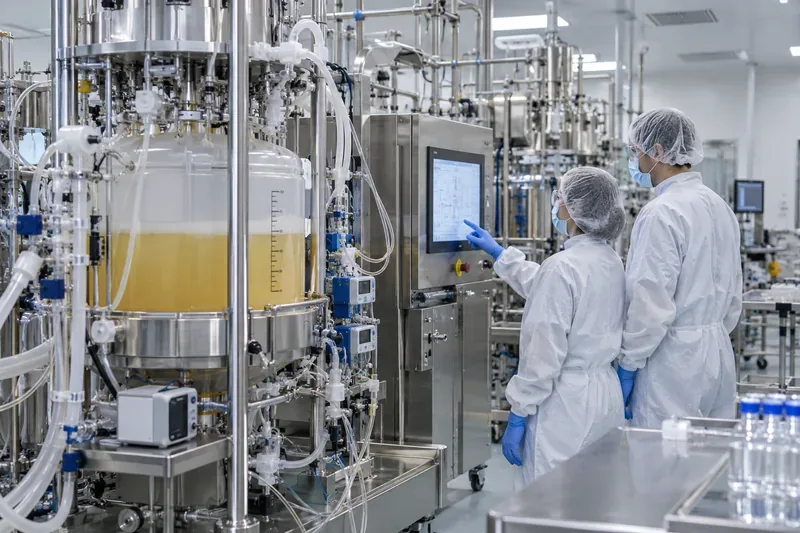
Modern biomanufacturing increasingly combines bioreactors, closed fluid paths, sensors, automation, and digital process control to shorten production cycles while maintaining quality oversight.
Quick reference: which breakthrough addresses which bottleneck?
Manufacturing approach
Primary problem it addresses
Best-fit use cases
Main caution
Continuous and intensified processing
Long cycle times, low equipment utilization, large facility footprint
Protein biologics and other processes with well-understood unit operations
Requires strong process understanding, residence-time control, automation, and contamination strategy
Perfusion and high-density cell culture
Upstream productivity limits
Monoclonal antibodies, recombinant proteins, some vector processes
Media demand, cell-retention performance, and control complexity can shift the bottleneck downstream
Platform manufacturing
Reinventing development for every new product
mRNA, related biologics, repeat product families, some gene-therapy workflows
A platform does not eliminate product-specific characterization or comparability work
PAT, automation, and digital twins
Delayed feedback and slow deviation detection
Processes with measurable critical parameters and quality attributes
Models must be validated, maintained, and governed; not every quality attribute can be measured in real time
Centralized production and long patient-specific lead times
Emerging RNA and individualized medicine models
Still developmental; quality control, validation, logistics, and regulation must scale with the network
1. Continuous and intensified bioprocessing moves the focus from batches to flow
Continuous manufacturing links unit operations so material moves through production with less waiting and fewer large intermediate holds. In biomanufacturing, the idea often appears as perfusion cell culture, continuous chromatography, continuous viral inactivation, or an integrated sequence of upstream and downstream operations.
The regulatory foundation is clearer than it was a decade ago. The U.S. Food and Drug Administration's ICH Q13 continuous manufacturing guidance, finalized in March 2023, describes scientific and lifecycle considerations for continuous drug-substance and drug-product manufacturing. It also discusses in-line and online monitoring and notes that some protein drug-substance attributes can be measured during processing, while other attributes may still require conventional release testing.
For biologics, process intensification is especially important upstream. Perfusion systems continuously add fresh medium and remove spent material while retaining productive cells, allowing high cell densities and extended operation. A current NIIMBL integrated continuous upstream project is developing a closed perfusion platform with media recycle and closed-loop control of productivity and critical quality attributes. The project is useful as a practical signal of where the field is heading, but it should not be read as evidence that every perfusion process is automatically cheaper or easier.
When continuous processing is worth considering
The product demand justifies better equipment utilization or a smaller manufacturing footprint.
The process has stable, measurable operating ranges and enough historical data to support control models.
Downstream steps can accept the upstream output rate without becoming the new capacity constraint.
The organization can maintain sensors, automation, residence-time models, and contamination-control strategies over long runs.
2. Platform technologies shorten development by reusing what is already understood
A platform is a repeatable manufacturing architecture that can support a family of products. The benefit is accumulated knowledge: common equipment, raw materials, analytics, control strategies, and operating ranges can reduce the amount of process development that must start from zero.